jueves, 18 de julio de 2013

Comparatives


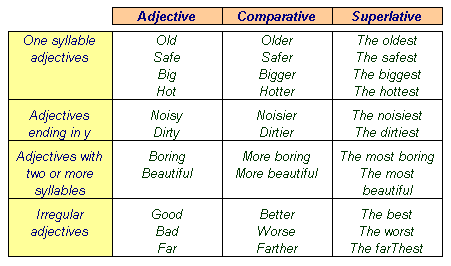
In grammar, the comparative is the form of an adjective or adverb which denotes the degree or grade by which a person, thing, or other entity has a property or quality greater or less in extent than that of another, and is used in this context with a subordinating conjunction, such as than. The comparative is one of the degrees


There are two types of superlative: relative and absolute.

Relative: John is the smartest boy in the class.


Absolute: John is very smart.

Present Perfect


We use the Present Perfect to say that an action happened at an unspecified time before now. The exact time is not important. You CANNOT use the Present Perfect with specific time expressions such as: yesterday, one year ago, last week, when I was a child, when I lived in Japan, at that moment, that day, one day, etc. We CAN use the Present Perfect with unspecific expressions such as: ever, never, once, many times, several times, before, so far, already, yet, etc.


Examples:
  • have seen that movie twenty times.
  • I think I have met him once before.
  • There have been many earthquakes in California.
  • People have traveled to the Moon.
  • People have not traveled to Mars.
  • Have you read the book yet?
  • Nobody has ever climbed that mountain.
  • A: Has there ever been a war in the United States?
    B: Yes, there has been a war in the United States.

Future with Going to


Going to future expresses a conclusion regarding the immediate future or an action in the near future that has already been planned or prepared.

Form of going to Future

 positivenegativequestion
II am going to speak.I am not going to speak.Am I going to speak?
you / we / theyYou are going to speak.You are not going to speak.Are you going to speak?
he / she / itHe is going to speak.He is not going to speak.Is he going to speak?

Use of going to Future

  • an action in the near future that has already been planned or prepared
    example: I am going to study harder next year.
  • a conclusion regarding the immediate future
    example: The sky is absolutely dark. It is going to rain.

Future with Will


Will future expresses a spontaneous decision, an assumption with regard to the future or an action in the future that cannot be influenced.

Form of will Future

 positivenegativequestion
no differencesI will speak.I will not speak.Will I speak?

Use of will Future

  • a spontaneous decision
    example: Wait, I will help you.
  • an opinion, hope, uncertainty or assumption regarding the future
    example: He will probably come back tomorrow.
  • a promise
    example: I will not watch TV tonight.
  • an action in the future that cannot be influenced
    example: It will rain tomorrow.
  • conditional clauses type I
    example: If I arrive late, I will call you.

Past Progressive


The past progressive puts emphasis on the course of an action in the past.

Form

 PositiveNegativeQuestion
I / he / she / itI was speaking.I was not speaking.Was I speaking?
you / we / theyYou were speaking.You were not speaking.Were you speaking?


Use of Past Progressive

  • puts emphasis on the course of an action in the past
    Example: He was playing football.
  • two actions happening at the same time (in the past)
    Example: While she was preparing dinner, he was washing the dishes.
  • action going on at a certain time in the past
    Example: When I was having breakfast, the phone suddenly rang.

  Family


Present Progressive


The present progressive is formed by combining the verb "to be" with the present participle. (The present participle is merely the "-ing" form of a verb.)

Example:

I am studying.


She is working


We are playing


Past Tense


The simple past expresses an action in the past taking place once, never, several times. It can also be used for actions taking place one after another or in the middle of another action.


Regular verbs:
Regular verbs form the simple past in –ed
Examples:

Leonardo da Vinci paint
ed the Mona Lisa. 


The teacher used a red pencil to correct the exams. 


I arrived yesterday 

Irregular verbs:

Irregular verbs do not follow this rule and you should memorize.

Examples:
You went to school last weekend

He bought a car. 

ate pizza yesterday


Present Tense


The present tense is a grammatical tense whose principal function is to locate a situation or event in present time. The term "present tense" is usually used in descriptions of specific languages to refer to a particular grammatical form or set of forms; these may have a variety of uses, not all of which will necessarily refer to present time. For example, in the English sentence My train leaves tomorrow morning, the verb form leaves is said to be in the present tense, even though in this particular context it refers to an event in future time. Similarly, in the historical present, the present tense is used to narrate events that occurred in the past

Examples:
  • play tennis.
  • She does not play tennis.
  • Does he play tennis?
  • The train leaves every morning at 8 AM.
  • The train does not leave at 9 AM.
  • When does the train usually leave?
  • She always forgets her purse.
  • He never forgets his wallet.
  • Every twelve months, the Earth circles the Sun.
  • Does the Sun circle the Earth?